Building Sustainable Microservices with bisslog python

The Problem: When Microservices Become a Mess
Building a modern microservice in Python seems easy — until it isn’t.
As the service grows, you start noticing problems:
- 🧱 Business logic tightly coupled to frameworks and infrastructure
- 🔍 Unit tests become hard to write and maintain
- 🔄 Switching from Mongo to Dynamo or SQS to Kafka involves rewriting logic
- 🌀 Architectural chaos: every service ends up with its own patterns and hacks
These issues don’t just slow down development — they lead to technical debt, fragile systems, and teams that can’t move fast.
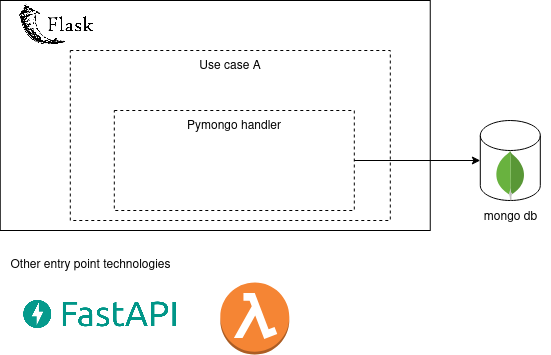
The Solution: bisslog + Hexagonal Architecture
bisslog is a lightweight Python library that helps you build clean, decoupled, production-ready microservices.
It brings a practical and framework-agnostic implementation of Hexagonal Architecture, giving you:
- 🔌 Ports and adapters for any infrastructure (Mongo, SQS, Email, etc.)
- 🧠 Use cases independent of FastAPI, Flask, or AWS Lambda
- 📦 Clean separation of input/output layers
- 🧪 Easier unit testing and mocking
- 📊 Built-in support for observability, validation, and error handling
- ⚙️ Automatic handler code generation for AWS Lambda (HTTP, SQS, EventBridge…)
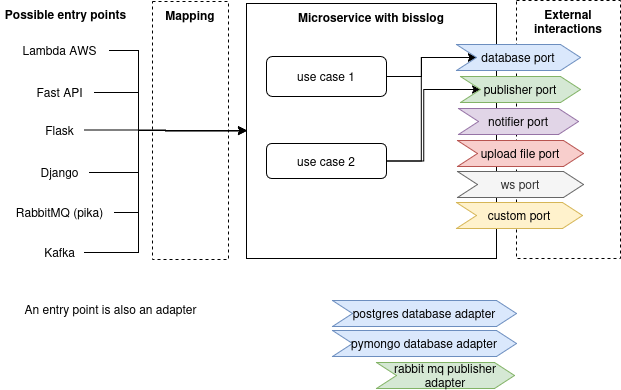
Example: Entry points (HTTP, events) talk to domain logic through ports. Infrastructure is fully pluggable.
Real Example: company-data-registry.microservice
To validate this approach, I built a reference service called company-data-registry.microservice.
It includes:
- 🏗️ Domain-centric use cases (no framework code inside)
- 🧩 Pluggable adapters for MongoDB and AWS Lambda
- 📝 A declarative metadata file describing inputs, outputs, and bindings
- 🚀 Auto-generated Lambda handlers with
bisslog-aws-lambda-py
1
2
3
4
5
6
7
8
9
10
11
12
13
14
15
16
17
18
src/
├── domain/
│   └── use_cases/
│       └── create_data.py
│       └── ... (more use cases)
├── infra/
│   ├── database/
│   │   ├── data_x_division.py          # Port definition
│   │   └── impls/
│   │       └── data_x_mongo_div.py     # MongoDB adapter
│   └── entry_points/
│       ├── flask/
│       │   └── setup.py
│       ├── fastapi/
│       │   └── setup.py
│       └── lambda_aws/
│           └── setup.py
metadata.yml
Modular structure: use_cases, ports, adapters, entrypoints, and metadata.
Bonus: Declarative Inputs + Generated Outputs
One of the key ideas in bisslog is this: you define what your service should do, not how to wire everything together.
With a simple YAML metadata file like:
1
2
3
4
5
6
7
8
9
10
11
12
13
14
15
16
17
18
19
20
21
22
23
24
25
26
27
28
29
30
---
name: "user management"
type: "microservice"
description: "Handles creation, update, and retrieval of user accounts in the system"
service_type: "functional"
team: "identity-platform"
tags:
  service: "user-management"

use_cases:
  registerUser:
    name: "register user"
    description: "Registers or creates a new user in the system"
    actor: "end user"
    criticality: "high"
    type: "create functional data"
    triggers:
      - type: "http"
        options:
          route: "/user"
          method: "post"
          apigw: "public"
          mapper:
            body: user_data
    external_interactions:
      - keyname: users_division
        type_interaction: "database"
        operation: "register_user_on_db"
    tags:
      accessibility: "public"
you get a full AWS Lambda handler, with body parsing, validation, response formatting, and trace support
From metadata → to auto-generated, production-ready handler.
What If You Want to Change the Framework or the Language?
One of the most common long-term problems in microservice development is technology lock-in.
With bisslog, you’re protected against that from day one.
🛠️ Switching Frameworks? Easy.
Because your use cases are completely decoupled from your HTTP framework, switching from FastAPI to Flask, or from AWS Lambda to an ASGI app, requires no changes to your domain logic.
You only need to:
- Replace the entry point adapter
- Rewire the handler (which can be auto-generated again)
- Keep your use case untouched
Your logic doesn’t care where the request comes from — and that’s the point.
🌐 Switching Programming Language? Possible.
Because bisslog enforces clean boundaries, your business logic is portable.
Imagine this:
- Your Python service grows, and you decide to rewrite the core in Go, Rust, or Java
- If your ports are well-defined and your core logic is framework-agnostic, the rewrite is scoped to the domain layer only
The rest (APIs, infra, observability) can stay in Python — or be gradually migrated.
This level of future-proofing is rare, and it’s built into bisslog by design.
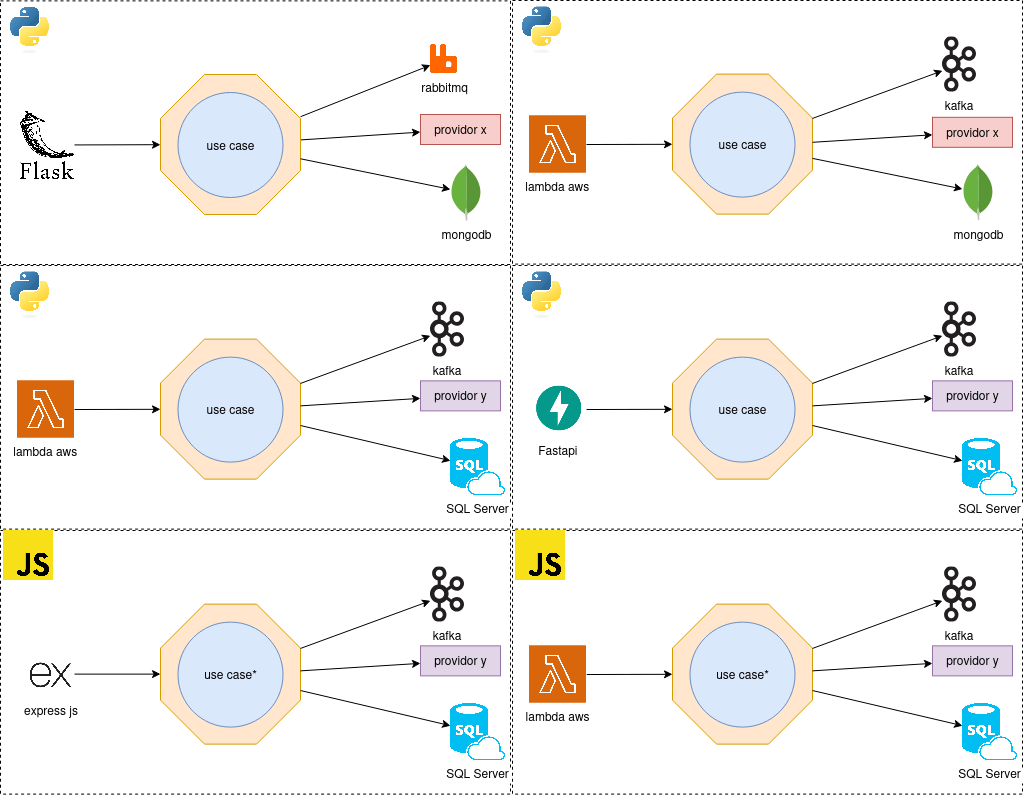
Use cases remain stable while frameworks and infrastructure evolve independently.
So… What’s Next?
If you’ve ever thought “this should be simpler”, bisslog might be exactly what you’re looking for.
I built this ecosystem with one mission: Let teams focus on domain logic — not wiring, boilerplate, or brittle architecture.
You’re invited to:
⭐ Explore the core repo: bisslog-core-py
🔬 Try the example microservice
🧵 Open issues, ask questions, or suggest improvements
🤝 Reach out if you want to adopt bisslog or contribute
I’m working on a short video walkthrough — follow @darwinhc on GitHub or check out the official docs to stay in the loop.